Stagnant Waters
on the irrelevance of cinema

Originally published in Cinesensuality Issue #1 Welcome to the Sensual World 5/7/2023
In film theorist André Bazin’s essay “The Ontology of the Photographic Image” he describes how the medium of painting faced an existential crossroads between being a means of directly replicating reality, preserving the past and embalming the dead, and being a symbolic form which expressed emotions beyond our ways of seeing. It was the invention of photography and, later, cinema that extricated painting from its expected responsibilities and allowed for the development of non-representational movements like impressionism, detaching the medium from a fealty to reality. You no longer had to have your memories preserved by a third party, a machine would directly replicate it for you.
Cinema as a medium has only existed for a scant 128 years, yet somehow it feels like we are at a similar crossroads. It is self-evident that humanity has moved at a faster rate of technological development in the past two decades than it perhaps ever has. As a result seemingly “modern” forms like cinema seem to be antiquated relative to history. Just as cinema itself absolved painting of some of its prior importance, it seems like the more nebulous concept of the mass media network of the internet has robbed cinema of its allure.
In her essay “In Free Fall: A Thought Experiment on Vertical Perspective”, filmmaker Hito Steyrel highlights a key philosophical shift in the late twentieth century with regards to how we see the world. In the past, your understanding of the world would be restricted to your immediate view. The idea of the horizon line became important for sailors and colonizers in their conquest of the Earth, guided by a linear perspective that shaped both their means of navigation and their ideological beliefs. However, linear perspective was eventually shuffled out by various technological developments. This shift was in part facilitated by the rise of the cinema itself and the moving image which provided the camera with an elasticity in its ability to capture reality from multiple perspectives. It was these advancements in camera technology that eventually led to the advent of satellites, whose cameras changed how we perceived the Earth geographically. Our view was no longer linear but vertical. Steyrel sees the shift to a vertical perspective as a guiding philosophical concept in understanding the modern world: we are no longer bound by what’s directly in front of us, and from a top down perspective there is literally no end to what we can see. We live in a time of endless free fall: of endless information, endless knowledge, endless discourse and endless access to every form of media.
Previously, cinema was one of the mediums best equipped to both shape and react to modern discourse. The horrors of World War II necessitated the creation of Italian Neorealism, as it was impossible to ignore the pains of immediate reality. Likewise the events of May 68 led Jean-Luc Godard and Jean-Pierre Gorrin to form the Dziga Vertov group to address the needs of the present, building on the momentum of this period of unrest by documenting revolutionary movements in Europe and advocating for Marxist ideologies. As Paul Schrader states in his short film PAUL SCHRADER, FUTURE OF MOVIES, 70TH BIENNALE DE VENEZIA (2013):
“When I first came into the film business it was in a time of crisis. Society was in upheaval. There was a drug revolution, sex revolution, gay rights, women’s rights, civil rights, anti-establishment. And the times required new themes, new heroes for movies”
The filmmakers of New Hollywood recognized the issues of society and produced work that directly addressed and led the discourse on these burgeoning ideas.
But this was only because the flow of information was glacial as compared to now, and immensely restricted by geographical borders. In the past, cultural discussions and arguments could take up years; now in the free fall they barely take up weeks. With the advent of social media and instantaneous communication you don’t need a piece of art to guide how you feel and think about a social issue, it comes as easy as scrolling through Twitter or Instagram for a couple of minutes. It is clear that cinema is no longer a medium that can start or match modern discourse, it can merely act as a postscript to a discussion that has already happened.
In the past, cinema was a medium of primacy and a way to gain immediate access to worlds outside your narrow perspective. There did not exist as strict demarcations between narrative and documentary, as seen through works like Nanook of the North (1922) which were partially staged yet presented themselves with the veneer of anthropological authenticity to an unassuming audience. The result was that the medium was regarded with a higher degree of objectivity than others. As much as artistic license was employed it was undeniable that the camera as a machine directly captured what was right in front of it. Yet with the rapid development of alternate forms of the moving image, television then and the internet now, this primacy has eroded. Now the world can only seem as objective as the digital image captured on your phone camera and any work of cinema can only ever feel premeditated. The consequences of this shift have been palatable: most people don’t watch and engage with the cinema anymore because it is irrelevant to their lives and unable to capture the rapid pace at which it moves.
It is of course impossible for a film to be produced at the speed of a Tik Tok or an Instagram infographic, but when placed in relation to these new forms of media its barriers to entry become glaring. Modern cinema as we know it, at least from our current vantage point, is the artistic medium most tethered to commercial interests and the flow of capital. To be a successful director today, and to be able to pay the numerous people working on your film, is to compromise, whether to the desires of investors and studios or to a dwindling budget. These constraints have always existed yet they feel all the more apparent in an age where films can’t seem to be produced fast enough to even get a word in. As much as we can grumble about watching cinema circle the drain, it is impossible to deny that cinema feels like a medium ill-equipped to directly address the issues of the modern day, trapped in a state of perpetual stagnation.
It stands to question that if photography liberated painting from a fealty to realism, will digital media do something similar for cinema? If reality is being more objectively captured by the portable image creation devices we all carry, and disseminated through mass, seemingly costless information networks, has the burden of realism for cinema finally been lifted? Contrary to this hypothesis it seems that in reaction to the hyperreality, the synthetic version of reality social media offers that feels more real than real, those within the world of commercial cinema have sought to assert the relevance of the art form by distinctly positioning it as a medium primarily used for replication. More specifically, cinema is seen as one of the primary modes of representation for marginalized groups, carrying a social responsibility to sensitively reflect our reality by capturing a diversity it has largely ignored throughout its history.
Yet even in this regard cinema seems outmatched by digital media. Whenever a film is released that directly positions itself as a landmark work of representation it is never as well received as it wants it to be, torn to shreds by the audiences it is meant to serve. Think-pieces upon think-pieces are launched against works as innocuous as Love Simon (2018), dissecting their effectiveness and authenticity, positioned against the barometer of lived experiences one can find on any social media platform. This in itself is indicative of the historic structural failures of the medium to capture life objectively. In the absence of consistent representation, digital media came to fill the gap that cinema could not, providing those from all backgrounds with tools of expression previously gate-kept by the industrial process of filmmaking. You no longer needed to have someone tell your story on your behalf, you could do it yourself. On the topic of representation cinema still feels like a postscript, with the release of a film only serving to legitimize a pre-existing social cause rather than to actively advocate for it. It’s too little too late and we’re constantly being served what we already know. In this case the revolution will truly not be televised, nor mediated by those with an economic platform, but disseminated through our phones.
What does it mean, then, if digital media has delegitimized cinema’s stake in replicating reality? On a practical level it means that our films feel distinctly untethered from the now. Because of the lag between a film’s conception and its release, work that attempts to feel topical like Rian Johnson’s Glass Onion (2022), with its various references to NFTs and parallels to real figures like Elon Musk, can feel incessantly gauche on arrival. If the work’s shelf life doesn’t appear to even last a week imagine how it will be perceived in years. It seems that for our most seasoned auteurs, or filmmakers who have enough clout to their name to push an original film into production, the way to comprehend modern discourse is to fully ignore it. It is telling that Paul Thomas Anderson has not had a film set in the present since 2002’s Punch Drunk Love (2002) or that The Safdie Brothers’ Uncut Gems (2019) is a period piece set in the recent past of 2010. There is simply too much discourse to untangle: too many significant political events, too many emerging cultural markers and hyper-specific forms of personal expression and identity. To attempt to address the now would run the risk of removing a timeless quality from your film. This is to the point that even films set in the present contain a conspicuous aversion to depicting smartphones and the internet, despite the fact that these places are where we spend 60% of our days. To even see texting translated through the language of cinema with such tact and ingenuity in films like Olivier Assayas’ Personal Shopper (2016) or Park Chan-Wook’s Decision to Leave (2022) feels uncommonly resplendent in a medium that mostly refuses to engage with these widespread modes of communication.
This conscious aversion to the present seems like a natural reaction for a medium that refuses to acknowledge its seeming obsolescence and irrelevance. Unlike painting it appears that cinema has not been extricated from its duties towards realism willingly, but because it simply cannot keep up with the speed of modern life. The medium as such, seems to be facing a similar crossroads, between being one primarily used to replicate reality and one used to present more symbolic forms. If cinema were to react in a similar way as painting it would appear that we are headed towards a period of reinvention analogous to impressionism, yet the medium’s current responsibilities towards representation seem to pre-empt this. It is thus clear that the crisis of cinema is not one between realism and symbolism but content and form. If any possible topic a film attempts to communicate can be better understood through the first person perspectives within digital platforms then will the content of a film even matter? Will we be in a new era where the art of cinema can simply exist for art’s sake?
But the real buried lede in all of this is that cinema can no longer bear a relation to a perceivable reality because reality has already been obliterated by the digital image. The physical medium of film itself was one intrinsically tethered to reality: it was the byproduct of a chemical reaction that immortalized a moment in time in the tactile object of a film strip. On the other hand, as soon as light hits the sensors of a digital camera reality is scrambled through code and the image immediately becomes immaterial. If film is a medium of life, creation and existence, digital, a medium of non-existence, is the medium of death. The digital image has evolved to a level of detail where it has become indistinguishable from reality, and the consequence of this is not that the images on our phones have started to appear more real but that our immediate reality has started to appear more fake. It may seem like I’m beating a dead horse, but it is unavoidable not to state that we are in a period of pure simulacra, where the virtual has fully replaced the real.
Cinema, as such, no longer has a duty towards realism because it has become impossible to distinguish reality from simulation. The next step for its evolution may not be to directly replicate the shreds of authenticity we encounter in modern life but to embrace the elastic reality that defines online spaces and which has seeped into the real world. One does not need to look much further beyond the most financially successful film of all time and its as absurdly profitable sequel to catch a glimpse of the medium’s future.
Both James Cameron’s Avatar (2009) and Avatar: The Way of Water (2022) cast reality distortion fields on every aspect of their production and conception. The world of the Avatar films bears absolutely no relation to any conceivable reality or any conceivable way of seeing: the cameras move through three dimensional space unbound by physical human means and the actors have their visage erased and replaced by digital surrogates. But more importantly, even as real world signifiers enter the film, any significance they have is rendered inert. The Avatar films are anti-colonialist, environmentalist manifestos that frame the American military industrial complex as the force that will completely obliterate the Earth and the galaxy at large. Its messages are so didactic that the success of the films should mean something, yet in no conceivable way have the Avatar films shifted the needle, affected the political climate or inspired passionate discourse. This is in part because its digital visage allows it to completely dodge questions of representation and identity. The films feature predominantly white actors playing roles that are obviously stand-ins for aboriginal and indigenous peoples, recreating past injustices that have decimated their communities. Yet these real world parallels lose any resonance under the layers of VFX. The content of Avatar is practically irrelevant and what you are left with is form par excellence. Art in which every conceivable piece of modern filmmaking technology is pushed to its limits. The common critique is that even though everyone went to see Avatar it somehow left no long lasting cultural impact or sparked any discussion. But from the way cinema is now situated in relation to discourse is this of any surprise at all? Avatar seeks not to meet the cultural moment or influence any long lasting change, it simply exists to be Avatar.
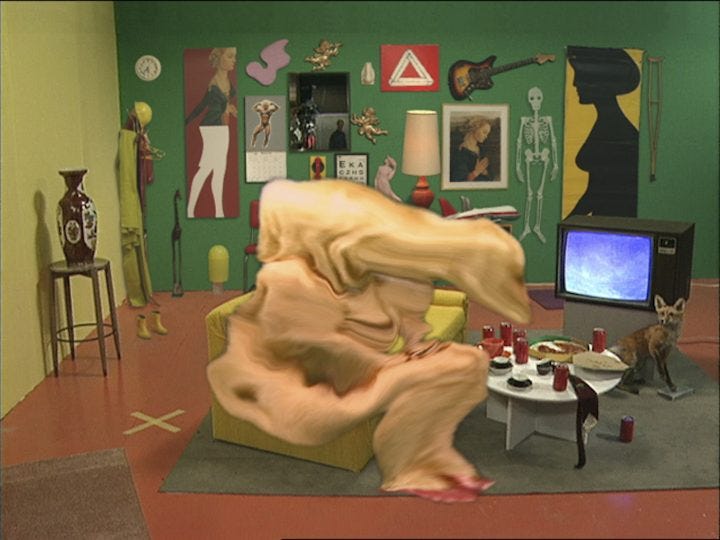
It is, however, not impossible to capture the same non-representational elasticity as Avatar on a fraction of a fraction of its budget. Perhaps the most prophetic, and most elastic, film of the 21st century has been Michael Snow’s *Corpus Callosum (2002). In *Corpus Callosum Snow replicates various quotidian scenarios: workers in an office and a family in a living room, with a digital camera. The quality of the camera already suggests a world of simulation yet the film goes further, as through VFX work, the bodies of the people captured squash, stretch, smear and distort, undergoing acts of digital transformation which are regarded with complete normalcy. *Corpus Callosum, like Avatar, comes to suggest that film should bear no fealty to reality and should exist in its own artistic void. Snow’s film effectively pushes the form of cinema as far as it can conceivably go just for the sake of a gag. The ultimate irony is that this distortion and defiance of reality does a better job at communicating the dysphoria one feels existing in both the physical and digital world than any faithful representation of reality ever could.
Yet, even as cinema appears out of step with how we interface with the world it is not completely inconceivable to think of a future where its language evolves to accommodate the pace of online life, being left completely subordinate to the dominance of digital media. It seems that to accommodate the free fall we need to reinvent cinematic syntax to move at a pace akin to the rapid flow of information you encounter on the internet. Lana Wachowski articulated these ideas of formal reinvention best when issuing a post-mortem on her film Speed Racer (2008) and detailing her attempts at instigating aesthetic change:
“Editing is a really interesting topic too because it's also aesthetic based. It is essentially the grammar of cinema, the sentence of cinema. And pretty much every movie since I was 9 was, you know, from a capital letter to a period. Scenes progress through a series of cuts, and maybe you throw in a dissolve, which is more of an ellipse, you know, instead of a period. But we were sick of that, too. And if you read postmodern fiction, something like Rick Moody's Purple America or James Joyce's Ulysses, you see these authors trying to transcend the boundaries of conventional grammar, trying to get your brain to think about language differently. And so we started trying to do that same thing with Speed Racer (2008). We said, 'Okay, we are going to assault every single modern aesthetic with this film.' And we said, Why do you have to use cuts? We want to do sequences that are like run-on sentences, stream-of- consciousness sentences that don't just start and end with the conventional cut, that are just montaged collages and flow the way, you know, what Joyce was looking for was the way that his brain experiences the world. Joyce said, 'I want to try to demonstrate the way my mind works as I'm getting all of this input and it doesn't cut things and it doesn't order things and it doesn't always make sentences.' There were moments in Speed Racer, like the races, where we just wanted them to feel like this experiential flowing thing that was transcending normal simple linear narrative.”
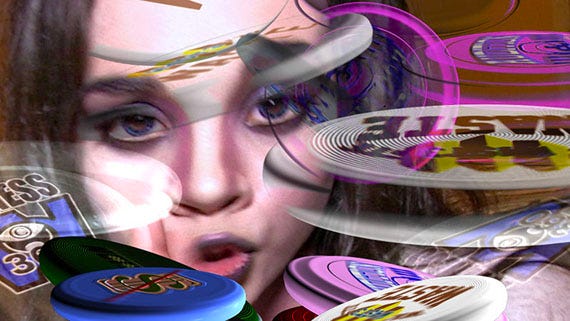
Speed Racer is in effect, the first true blockbuster of the free fall, as a film that presents its visual ideas not through a restrictive linear perspective, but from the top down vantage point of endless visual stimulation. But the film that perhaps best translates the experience of living in the post-internet simulacra of the free fall is Ryan Trecartin’s Center Jenny (2013). Trecartin’s film follows no discernible structure and no tether to any non-virtual reality. The film captures a cavalcade of performers, who have their visage obscured by garish metallic makeup, who in a valley-girl cadence speak exclusively in non sequiturs. To the viewer the world the film presents is completely alien, with the only discernible referent one can find being the meme-culture spawned by the internet. The film is edited in an arrhythmic manner, like a stream of consciousness, with new ideas, both visual and verbal, being introduced at practically every second. And like Speed Racer the conventional cut is wilfully ignored as multiple scenes occur superimposed on top of one another, with there no longer being a clear demarcation as to when a scene or an idea starts and ends. What binds everything together is a shared narcissism, as the film’s performers are fully aware of the position of the camera, which is sporadically visible in the shot and of which there are multiple in the background of most scenes. In the world of Center Jenny, reality does not exist to be experienced as much as it exists to be affirmed by a camera, and the distinction between real and virtual has fully eroded. From the pure form of the film various truths about contemporary life spawn: that even as we have become more interconnected our experiences on digital platforms have become incessantly individualized and solipsistic and that to properly depict the rate at which information flows on the internet is to depict a perpetual state of schizophrenia.
Adopting the syntax of the internet in film does not always suggest a state of complete stimulation and in many regards it can mean a swing in the completely opposite direction. For most people the experience of watching a film can feel like an entire intellectual ordeal. There is the issue of dwindling attention spans but also the feeling of fatigue one feels in the free fall when all information is constantly accessible. Most films, or at least the good ones, aim to address lofty philosophical ideas regarding the structure of society, the complexities of relationships and the nature of existence. To watch a film is to willingly allow these ideas to percolate in your mind, yet in our state of constant stimulation the experience may feel overwhelming at best and tiresome at worst. This is partially why Tik Tok as a platform has gained such prominence. Short form content bears no claim to addressing heavy ideas, it is merely satisfied offering the viewer micro-experiences: brief anecdotes or tutorials that focus on the minutiae of life. To use the internet is to navigate the free fall by accumulating these micro-experiences and being exposed to multiple smaller ideas as opposed to larger ones that come in the pre-packaged form of a film. An example of a post-Tik Tok film is perhaps Lilith Kraxner and Milena Czernovsky’s Beatrix (2021). The film does not follow a conventional story structure and instead consists of individual scenes of the titular character undergoing various tasks: Beatrix watches TV, Beatrix brushes her teeth, Beatrix has dinner with her friends and so on. One can argue that a film like this is structured in a way wherein the scenes accumulate to suggest larger ideas, yet when watching it one is mostly reminded of the micro-experiences communicated by Tik Tok. The refreshingly down to earth allure of a film like Beatrix, as such, seems to stem from how the film hews closely to the distinctly contemporary ways we comprehend reality through modes of depiction which have been completely dictated by the internet.
In assessing these examples it has become abundantly clear that while it was the language of cinema that initially informed the creation of digital video content, we are arguably in an age where cinema’s future will be shaped by its successor. For cinema to have any tendency towards relevance is to engage with the aesthetics of the internet, being second fiddle to a dominant medium. But more pressingly, perhaps the last stake cinema has as a medium focused on realism is to finally acknowledge that the virtual world is as much a part of reality as anything else. Jane Schoenburn’s We’re All Going To the World’s Fair (2021) offers a compelling model in this regard. In their film there is no distinction between life that unfolds in person and life that unfolds on screen, with the film transitioning between footage shot on professional digital cameras, footage shot on web-cameras and YouTube videos from individuals across the globe. The effect is seamless and it presents a more realistic depiction of everyday reality than most films of the past decade. Cinema ultimately needs to shift its understanding of reality from the corporeal aspects of the world you can smell, touch, see and feel, to just what your eyes can perceive. After all, probably around 60% of our lives is spent staring at virtual screens.
In the dilemma of content and form the various paths cinema can take have started to become clearer. It could still attempt to prioritize content and strive for cultural relevance, but this would involve becoming a medium completely subordinate to the aesthetics of the internet. The Daniels’ Everything Everywhere All At Once (2022), for example, is a work that cannot exist outside of the free fall, matching the rhythm and cadence of the bottomless pit of information online. Any supposed freshness the film has is not from its ideas but from seeing aesthetics most people are abundantly aware of repackaged into the antiquated form of a narrative film. Again, it is merely a postscript that legitimizes online ideas rather than presenting anything new. The other option is to of course stay embalmed and embrace form, art for art’s sake in spite of irrelevance and become fully untethered from the wisps of reality like Avatar or *Corpus Callosum.
To envision a healthy future for cinema we can look to the example of the medium it changed. If one were to go to an art gallery today you’d see work of all sorts: realistic, symbolic, accessible, incomprehensible, in complete coexistence and occasionally harmony. The cinema did not erase its focus on realism but liberated it from being bound to its prior duties to reality, unleashing a world of immense diversity and experimentation. This comes from the flexibility affronted to what a painting or a piece of fine art can be, which is practically anything. Cinema on the other hand is still wrapped up in inane semantics and gatekeeping. Twin Peaks: The Return (2017) can be a film but Watchmen (2019) cannot, a short film can be under a minute long but a Tik Tok cannot be a short film. It seems like cinema is still bound by its economic constraints, where the legitimacy of a film is tied to its mode of “proper” distribution or its recognition by an elite institution like a film festival.
It now appears that cinema will continue to remain a medium that gives equal weight to content and form, carrying the baggage of both. We will not witness the death of content and the triumph of form just as realism in painting did not ever truly die out. But despite its best efforts, for the foreseeable future cinema will remain irrelevant. As healthy a state fine art is in, it is undeniable that it bears no relevance to the lives of many, with galleries existing as niche, cultural institutions seemingly only worth an infrequent visit. It is not hard to see that the halls of the movie theater are suffering a similar fate. It may be depressing to realize but if one were to invest their time into studying the evolution of the moving image and its radical potential, they would now have to look way past the narrow definition “cinema” provides.
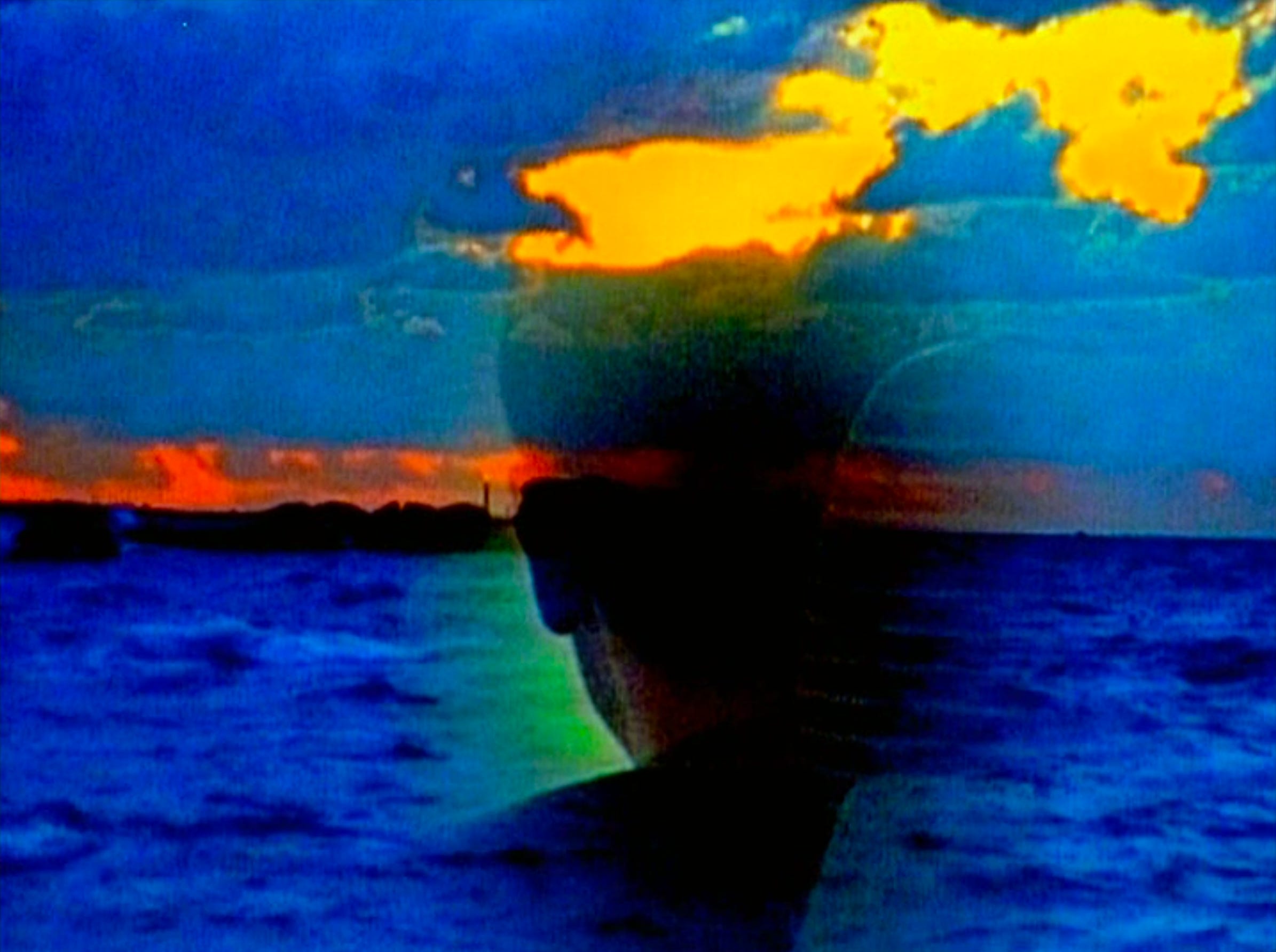
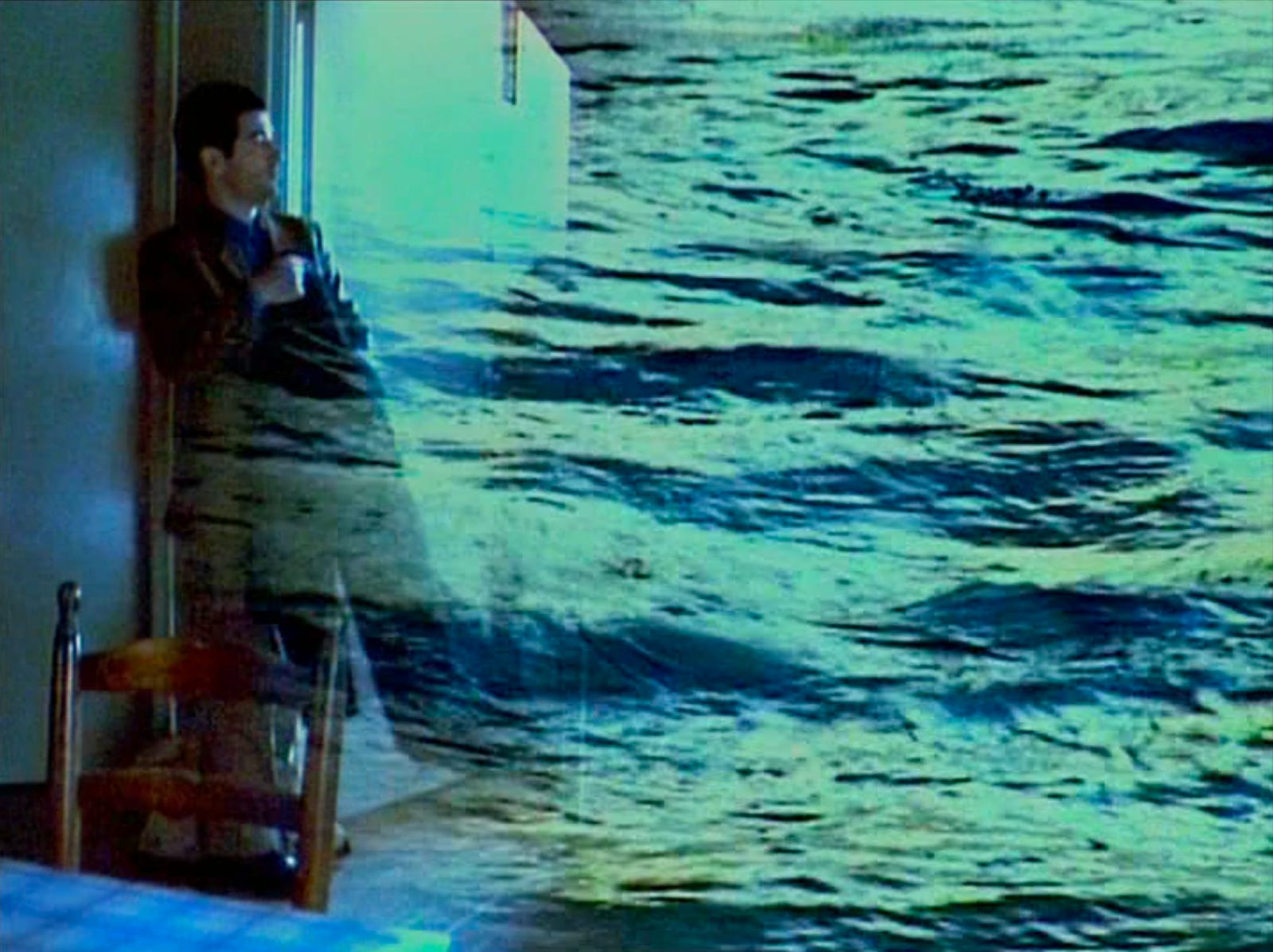
Yet in all its failures it is hard to deny its beauty. Midway through Jean Luc-Godard’s In Praise of Love (2001) the film's visual style makes a hard shift. The first half of the film captures the world through intimate black and white footage as shot through Mini DV. The intention is clear: an early digital camera can present a view of reality more recognizable to the layperson, and if the digital image is more real than real then the film’s format draws it closer to capturing realism. But in the second half Godard uses the nature of the digital image to completely detach the film from reality. Color floods back in, but because of the way the camera's sensors pick up light the image appears saturated and artificial. This artifice becomes key to the film as Godard superimposes images upon each other like a stream of consciousness. The blurred colors come to actually resemble an impressionist painting, and life appears more vivid, in fact, as vivid as the world we see on the screen, with the distinction between either completely erased.
The only way to cope with seismic change is to find a new way to speak, and though that seems daunting, that is where we need to start.